
Sometimes, when a dog comes to us, it has so many issues that it is hard to list all of them. Izzy was one of such dogs.
Her whole being was completely overwhelmed by the feeling of insecurity. Izzy’s display of insecurity was unusual in that sometimes her fear would make her bark (reactivity) and at other times she would have a tantrum and a complete meltdown with bouncing and thrashing, trying to get out of her collar, putting her paws on her person, whining with eyes bulging, and looking completely and utterly lost.
Prior to coming to us, Izzy’s owner had made multiple attempts at teaching Izzy how to control her emotions. They took classes with different trainers, group and private, and sought an advice of a behaviourist. They have tried approaches that are labeled as “positive-only” and “balanced,” and nothing seemed to work. Instead, Izzy’s reactions seemed to be getting worse.
Things got intense, life with such a dog—difficult, and at some point, upon consulting with the veterinarian, it had been decided that the dog will need to start taking calming or anti-anxiety medications, and it will have to stay this way for the rest of her life.
When Izzy first came to our class, she was a shell of a dog. She handled herself okay and the problems described by her owner did not show themselves. However, it was very clear that the dog’s mind is fogged and not fully present. This is the sort of thing we see with dogs on anti-anxiety meds, which is why I always ask that the dog is weaned off any stress-reducing drugs.
Of course, sometimes this weaning process takes days and weeks, which was the case with Izzy. However, little by little she started emerging from her shell. Whenever she displayed signs of anxiety, we helped her owner to deal with it kindly and confidently.
My personal favourite moment was when Izzy saw a donkey at the horse farm where we are training. She saw this unfamiliar to her animal and completely lost her mind, thrashing and trying to get away from it or, preferably, just disappear from the surface of the planet.
It might not have been a very proud moment for her owner—up to this point we did not really see many tantrums from Izzy—it was a truly happy, wonderful moment for me personally. Because I finally got to see a real dog, with her feelings and fears, and this gave me a good understanding of how to help her overcome the issues she was dealing with.
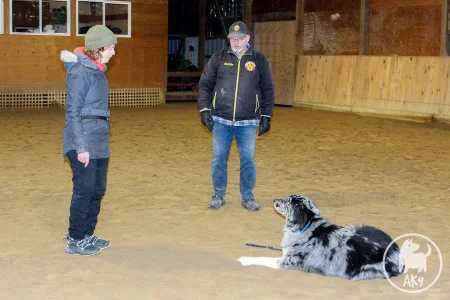
Izzy took two courses with us, and in one of the pictures below she is staying in a long “down” while her owner is standing at a distance from her, leash on the ground.
It might seem like nothing, but Izzy’s insecurity would not have let her keep this “down” and not go after her owner just a few weeks ago. This ability to calmly remain in a certain position and watch her person go away is something that speaks to Izzy’s gained confidence in social situations which were absolutely unimaginable before.
In another photo Izzy is letting Bernie touch her. She does not bolt, does not bark, and is not trying to avoid the contact with a stranger—another amazing achievement for her.
Finally, in the third photo Izzy is calmly chilling in a “heel” position while her owner is listening for the instructions and feedback. Izzy is sitting in close proximity to other dogs, and she is not fazed by it. Her leash is loose, and her body language is relaxed, polite, and mildly curious.
The transformation of this dog’s attitude is simply astonishing, and we truly hope her life from now on will have much less anxious and stressful events because now she understands how to handle such situations.
For us as trainers, cases like that are particularly dear and valuable. We know that we were able to help one more dog, and this is a good thing to know. Izzy did well.