
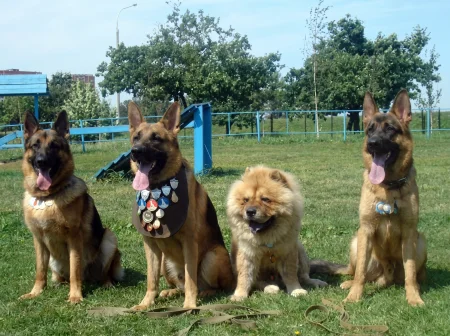
“Do you work with difficult breeds?” – this was the first question someone asked me today on the phone. It was early in the morning, and my brain still needed more caffeine to begin functioning properly. Therefore, I did not understand what a person meant, thinking that they might be talking about dogs who acquired a lot of bad habits.
It turns out, by “difficult breeds” they meant Asian breeds – Chow-chow, Akita, Shiba-Inu, Tosa-Inu. I have worked with quite a few of them, and I owned two Chows in the past, and this is not the first time I hear people, especially trainers, referring to these dogs as “difficult.” This makes me think: why do people call them that and why should anyone refuse to work with these breeds?
First, I would like to clarify what it means when someone says “easy to train” or “difficult to train.” Dogs who are easiest to train are motivated. This motivation can take all forms and shapes, and it simply means that you do not need to come up with anything creative to make your dog like working – an “easy” dog comes wired this way. They will work for food, for toy, for praise, for pets.
The next level is represented by a huge range of dogs with some motivators being noticeably present, and others weak or non-existent. Most encountered motivators are desire to follow food (food drive) or to chase a toy (prey drive). They are not always strongly present but can be developed with some work. These dogs are “trainable” but not necessarily “easy.”
And then come “difficult” breeds, or breeds that demonstrate very weak motivation to work for food, praise, or toy. It does not mean, however, that they are not trainable or that they are, indeed, difficult to train. A simple change of mindset will do—these dogs are still live beings, and live beings will always, always have something that they find rewarding. In other words, they can be described as creatures who are very prone to bargaining as long as you can offer something worth their time. This can mean that you need to show your Chow that they can go ahead and sniff that bush if they heel for you.
In other words, if a dog does not immediately jump out of its metaphorical pants when you show them a piece of dried liver, it does not mean that they are difficult to train. It just means that you should keep that liver to yourself, do some observing and thinking, figure out what it is that this specific dog enjoys, and then make a reward event out of whatever it is.
Refusing to work with “difficult” breeds equals to refusing to think, and refusing to think is the last thing you want to see in a person who will be helping you train your dog. I work with dogs, and I do not care what their breed, size, age, or gender is. Dogs are dogs, and training is training—as simple as that.