
Those who see as many dogs as we do know very well that, despite what social media and Hollywood movies tell people, dogs come with a whole range of personalities — and not every one of those personalities is pleasant or easy to live with.
In fact, the entire point of purebred dogs is selecting for traits and temperaments suited either for specific work or for life as a stable companion animal.
Unfortunately, first-time owners, often influenced by unrealistic ideas of what dogs are “supposed” to be like, sometimes end up with a dog that either has far too much energy or an unstable temperament. And “unstable temperament” itself covers a very broad spectrum: spookiness, anxious urination, over-arousal, redirecting, environmental sensitivity, and more.
One particularly difficult category is the combination of unfortunate genetics and inexperienced handling: a dog that is naturally fearful and insecure, but that has also been coddled and allowed to avoid all discomfort because the owners felt bad for it. The problem gets worse when any attempt to set boundaries or apply even mild pressure results in the dog acting all abused and in pain.
We have seen several dogs like this in group training. They are not easy dogs, and they are not for the faint-hearted.
Any kind of pressure — social pressure, spatial pressure, physical handling, environmental pressure — can send them into a meltdown. Their coping mechanisms are usually one of three things: bolting, biting, or collapsing into a dramatic alligator roll.
The hard part is not identifying the reaction. The hard part is resisting the emotional urge to immediately back off the second the dog starts screaming, flailing, or panicking. Because the moment all pressure disappears, the dog learns that the behaviour worked.
In fact, a dog who resorts to this screaming, bolting, biting, and rolling as a response to pressure is not in pain. They have simply learned that these strategies are effective because they have already been reinforced, often repeatedly.
Someone tried to put a collar on the dog — the dog snapped — the collar went away. Lesson learned.
Someone tried to walk past a distraction — the dog pancaked on the ground — the walk stopped. Again, lesson learned.
Dogs like this need to learn two things:
a) these strategies do not change the outcome, and
b) pressure is a normal part of life.
And no, this is not about intimidation or “dominating” dogs. It is about showing the dog the realities of this world.
Start simple.
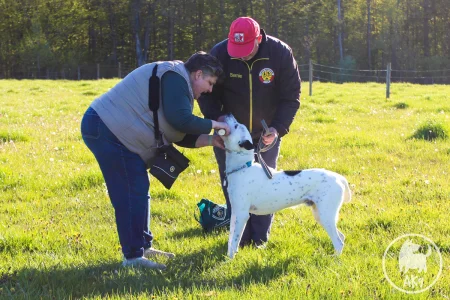
Handle your dog. Touch the feet, ears, tail, belly, mouth. Brush the dog. Move the body around gently. Teach the dog that being handled and experiencing restraint is normal.
If the dog gets uncomfortable, stay calm and fair. Don’t immediately stop the session the second the dog protests or melts down. Finish what you started, let the dog work through it, and adjust accordingly next time if needed. Reward at the end.
That principle applies to almost everything in dog training: finish what you started, stay fair, stay observant, and adjust thoughtfully instead of emotionally.
Good training is usually very simple — and those simple things prevent an enormous number of problems later on.