
Something astonishing had happened this weekend.
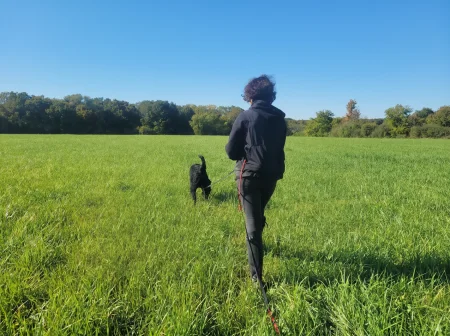
A few members of our Schutzhund club and I went out tracking early Saturday morning. We normally divide the available field into “areas” in a way so that our tracks do not intersect or come overly close to each other.
This week, however, me and another person misunderstood each other in terms of where our “area” was, and we managed to not just overlap but actually lay a whole leg of our track in the exact same spot—it further occurred to me that we used the same tree (there aren’t many) as our focal point.
Anyhow, I took my dog tracking first, completely unaware that we laid a track on top of each other’s footsteps. Everything seemed great and normal until my dog found an article (this is how we call a “lost” item that the dog is looking for) which was not mine—it belonged to that other person who laid their track next to me. Or so I thought at least.
I felt cold, sticky sweat running down my back as I started realizing what this meant. To be clear, that meant that I lost control over which track my dog was following. If the two coalesced into one—how would I know that she was still following my footsteps? Oh, and what do I do about the found article which was not mine? Pretend it is and reward a dog? Or pretend it isn’t and send her further down the track? As all these thoughts were racing through my head, Bernie, who was behind me, suggested that I just let my dog work and lock my emotions for later. After all, I knew my focal point—the tree—and knew that my track was making a sharp left corner after that tree.
So I let my dog work and kept my panicky thoughts about inability to control anything at this point to myself. I sighed in relief after my dog turned left (she was following my track!), and then another scary thought descended upon me: how do I tell that other person about my track being on top of theirs?
Me and Bernie quickly mulled this thought over and decided to let that other person’s dog work, too, without telling its owner about the coincidence and, therefore, without facilitating any stressful feelings prior to the track. And you know what was interesting? The other dog had no problems whatsoever following the track over which me, Bernie, my dog, and another person stomped.
What does this all mean? It means that your dog can see, feel, and smell your stress and uncertainty. If you do not know what to do or if you send them signals that you do not trust them, then this is how things will be with your training: confusing, abrupt, unreliable. Conversely, if you project confidence with your whole being—or at least, you pretend that you do—the dog will react to this disposition accordingly.
Of course, we are all humans, and stressful things happen. A very simple trick that can greatly improve your training, though, is to not take that stress with you to the training session. Leave it at home for some other occasion.