
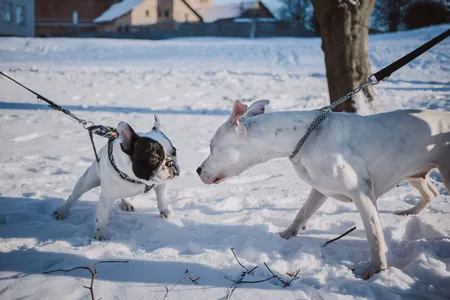
The following scenario is familiar to most dog owners.
You are strolling in the park, your dog is on leash, you are enjoying the blissful peacefulness around you or, perhaps, thinking about all the tasks that you need to complete today. Out of nowhere, you are being charged by an off-leash dog. It approaches fast and has no intention to stop. You are turning your head, searching with your eyes for an owner, but such a person is not anywhere in visible proximity. The strange dog, as it gets really close, freezes on its tiptoes; hackles are up, ears folded against his head and to the back, tail straight up – the dog’s whole body projects stiffness which might instantly turn into an aggression outburst. In response, your dog stiffens up as well.
Finally, you hear a faint voice from somewhere afar: “Don’t worry! He is friendly! He only wants to play!” And as soon as the “play” part of the phrase is said, the strange dog attacks yours.
From here, the number of possible outcomes is countless. However, it all ends with the same words spoken by a strange dog’s owner, “I have no clue why he did that, he never has done it before!”
Of course, a strange dog does not always attack. Sometimes, when you have enough obedience on your dog and you just continue heeling and ignoring a possible threat, the strange dog gets a message and leaves you alone. However, more frequently it will try to yap and bark at your dog and maybe even nip their rear end.
Here is a number of “friendly” off-leash dogs I have encountered and the situations I have been through:
- A dog approaching my dog from behind and nipping at its tail.
- A dog getting into my dog’s face and instigating a fight.
- A dog coming straight at my dog and taking a chunk off its side without any warning.
- A dog coming in behind me while I am playing with my dog. That dog went after my dog’s toy. Not cool.
- A dog running towards my dog while we were tracking. That dog had no intention to attack but also could not care less about her owner. She slowly munched on food I left on the ground, then pooped on my track and left. Also not cool.
- Finally, I have seen multiple times how dogs in pet-friendly stores drag their owners to other people’s kids, then start jumping at those kids, licking their faces, knocking them down, and pretty much scaring the hell out of them. To that, dog owners usually say, “he loves children so much I cannot hold him when he sees them.”
The whole “he is friendly” phrase usually carries two big messages, “my dog is loose, and I have no control over it” and “I have no clue whether it is going attack you, but because I said that it is friendly you should relax and my dog will hopefully relax too.”
If you are an owner of a “friendly” dog, think about how much it sucks to be on the other side of a situation. Even if your dog truly is friendly, it does not necessarily mean that the other dog is friendly too. Moreover, on-leash dogs are almost never friendly when they are being approached by an off-leash dog. They experience invasion in their personal space, and very few animals – and people for that matter – are going to take kindly to it. If your dog got off leash by accident and you do not have a good recall, it is much kinder to yell, “Watch out, loose dog!” than “Don’t worry, he is friendly!” And then come and get your dog as quickly as possible. Meanwhile, a person who is being approached by your dog will feel much better if they receive a fair warning, even if your dog brings no harm.
If you are deliberately letting your dog approach other dogs because you believe that this is what socialization is, you are consistently creating a terribly dangerous situation for both involved parties. You have no clue of the history of that other dog. It might kill or injure your dog in a matter of seconds, even before you have a time to complete infamous “he is friendly” sentence. Your dog might get kicked in the face by the other dog’s owner who is protecting their pup. It might be pepper-sprayed, yelled at, bitten at – you truly do not want to be adventurous about it. It is much better to find a few friendly dogs who are safe to play and socialize with.
Finally, grab a long line and start working on your recall. Until you can trust that your dog will return to you on your first command, there is no letting off leash. Because each time your dog got loose and ignored your command, it rewarded itself by reaching an object they were really curious about. And no creature will easily give up what they find extremely rewarding. First, you need to stop this kind of rewards from coming (never let your dog run off) and second, work on making your own presence more rewarding through play, food, movement – whatever your dog likes.
On the other hand, if you are a person whose leashed dog is being approached, the best course of action is to insert yourself between your dog and a strange dog. This can be achieved in a variety of ways – through basic position, sit-stay or down-stay, even through making your dog to hold an object – but the point is: protect your dog while keeping them under control. This takes the responsibility of making a decision about a strange dog off them, which they are going to appreciate, and it will positively affect your relationship through developing more trust. Using your body to restrict an access to your dog is called “spatial pressure” and it is very effective with most dogs, who will likely back up and keep their distance from you. It might even prevent them from approaching your dog or any other dog next time.
No dog should be forced into a situation where they might get injured. A fleeting moment where you feel good about letting your dog run free can turn into a really ugly scenario, real fast. Of course, sometimes accidents happen, and young and untrained dogs wiggle out of their collars. However, doing nothing about that is just as bad as deliberately letting your off-leash dog approach other people’s leashed animals.