
I admire how the very name of this training tool plays into the widespread hysteria about all other training tools being un-kind, inhumane, un-gentle.
It is pretty brilliant, truly! You read about “gentle leader” on internet, you see the video of a seemingly happy dog who is calmly walking next to their smiling, satisfied with their training skills, human. All of that juxtaposed with malevolently looking prong collars, choke chains, and (o horror!) e-collars that undoubtedly were created by a sick individual with a twisted mind whose sole purpose was to hurt all the animals into submission, and all of that happened long time ago, when cruelty towards animals was normal. But society has changed since then, right? Gentle tools must be prioritized. Hence, you click that “buy” button and feel good about chances of your training and your overall future with your dog, who will certainly appreciate your humane and gentle approach and will behave accordingly. Or will it?
Dogs who are attached to “gentle” leads are everywhere. You can see them in parks, in school yards, in hardware stores, in vet clinics. They seem calm and well-behaved, which makes everyone believe that this tool is effective. It works. Which brings me to one of the two main points: what is a training tool and how can we assess its efficiency?
Training tools essentially do just that – they help people train certain behaviours and skills. They do not replace the process of training but used in this process in order to facilitate faster achievement of specific results. None of them are magic wand or “quick fix” to pulling or barking, and they are completely useless and often harmful in hands of those people who have no clue how to use them.
Leash is a tool that helps us communicate with our dogs with the help of directional pressure – if pressure on the leash occurs, the dog knows that, in order to relieve this pressure, they need to change something about the way their body is positioned in this specific moment in time and space. Prong collars help deliver a correction. E-collars can signal a variety of things – from buzzing that precedes reward to yet another way to correct a dog. Once the desired behaviour is established, the use of a tool is minimized to the point where there is no more need for it and the dog knows what it is being asked to do without any help. A tool is considered efficient and effective when this desired result occurs.
“Gentle” leader is a tool which can help to teach a dog one single thing: to walk calmly on leash. There is nothing wrong with this specific goal per se; however, what is very wrong with the whole culture around this tool, is the fact that once people put it on their dogs’ faces it stays there during the walks forever. It is considered very humane, absolutely painless – it is “gentle” after all, is it not?
And here comes my second point: no, it is not. The fact that this tool features no scary prongs or is not a conductor for electric current does not automatically make it a positive-only, all ponies-sugar-butterflies instrument.
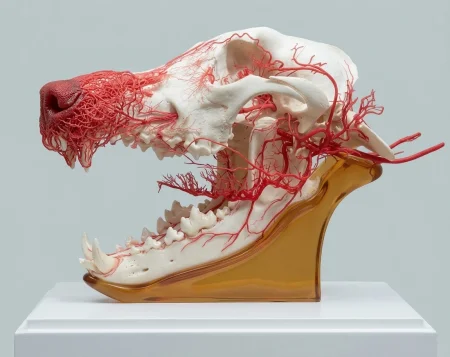
Attached to this post is a picture of a dog’s facial vasculature. As you can see, the very area on top of a nose is highly vascularized. What does this mean? It means that there is a LOT of blood supply to this area, and that this is one of the most sensitive parts of your dog’s body. Putting anything potentially tight around their face is not comfortable and definitely not “gentle.”
The mechanics of “gentle” lead presupposes that it is put around a dog’s face and each time a dog attempts to pull or jerk, it will tighten and shut their mouth closed – which is essentially a correction that could be done with the help of any other training tool, starting from very plain collar and leash to prong collar to e-collar. What makes this tool highly effective is that it prevents pulling by causing a decent deal of discomfort, arguably even more than a prong collar will. To avoid discomfort, a dog begins to walk nicely. But once the tool is off – they go back to their regular exuberant selves. Therefore, “gentle” leader becomes some kind of a crucial first aid to people who use it – their dog walks perfectly fine while wearing it and transforms into an unruly demon when this tool is taken off.
From the training point of view, it makes sense: a dog was never taught how to walk calmly on leash; however, it learned that, while the “gentle” lead is around their face, any jerky movement will cause a discomfort. Avoidance of discomfort is not the same as understanding what it is that they are expected to do. It is not training – it is management, and poor management, for that matter.
Think about training tools as instruments, such as a hammer. A hammer is a violent tool, isn’t it? It can be extremely dangerous in hands of a child for both the child and for people surrounding them. But it is a useful instrument, too. You can use a hammer to drive nails into something, for example. However, you will likely not use a hammer to open plastic boxes with cookies or to close the door of a microwave – even though you technically could, and it would be pretty effective. The point is: you only use specific instruments for specific purposes. Yet, for some reason, “gentle” leaders, which are a specific-purpose instrument just like a hammer, are used as a replacement for regular flat collar, every day and every second while dogs are on leash and outside.
Finally, to clarify matters regarding my own position: I am not against the use of any training tool. I believe each of them can find a place in a dog trainer’s repertoire depending on a case they are dealing with.
But I am vehemently, adamantly, passionately against false advertising. If I know that a prong collar is supposed to be used for corrections only, I am not going to put it on my dog unless I plan to train. I am not going to take my dog for a lazy on-leash scroll wearing an e-collar – there is no need for it in this specific environment. I am not using my hammer to drive a piece of bread into my toaster, and I am not pushing my keyboard buttons with it either.
Please take off those pink-tinted glasses and shake off the feeling-good-about-yourself attitude. No tool replaces training, not even a “gentle” leader.
You are not training your dog and you are not teaching them anything either. In fact, you are continuously correcting them for something that you did not bother to teach in the first place.
By applying a quick fix such as “gentle” lead is, you are sentencing your dog to wearing a correction tool for the rest of their lives, which is neither kind nor “gentle” – it is unfair and cruel, and it is poor management. And you know what happens with poor management? It will always, always fail you.