
As all our clients know, I always take Orca with me to the training. For most of the class time, she hangs in a “down” position somewhere to the side, either on her raised bed (when it is cold) or on the ground (when it is warm).
When I need to demonstrate something, I call her and show whatever I need; when the demo is over, she goes back to her place. She consistently “stalks” me, anticipating that moment when I will need her assistance—she lives for these moments. However, as much as she wants to be with me and do things, she does not usually break her “down”; is completely disinterested in other dogs; and never rebels against anything.
From time to time, people who are very new to dog training inquire: how long does it take to train a dog to this level?
There are at least two answers to this question, both of which are truthful: it either takes about two-three months, or it takes a dog’s lifetime.
If “this level” is defined as specific to the time and place where a desirable behaviour was observed (in a group class setting), then it takes only a few weeks. The very people who ask this question often witness that, by the time we are done with them, their dog has no problems keeping a long “sit” or “down” (with a few exceptions). Teaching a long “down” is not hard in terms of technical implementation. There are really only three steps: teaching the command-action association; teaching duration; and proofing both association and duration. Your success is directly proportionate to the time and effort you spend on following these simple steps.
However, if “this level” is defined by a dog’s ability to perform a behaviour in any life scenario, then lifetime is the honest answer.
Example: my dog has a brilliant recall. She knows all the regular obedience commands (and some more); she loves working; and she loves to show off by being fast and flashy. In 2024, we won the highest obedience score (97/100) in IGP sport in Canada. In other words, Orca is pretty biddable.
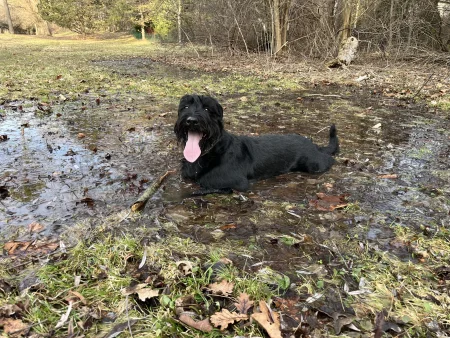
The photo below was taken last week. We were walking in a field by the woods and enjoying each other. I threw my dog a stick; she chased it and brought it back, and we did that sequence many times until she got tired and too hot. At that moment, some kind of malfunction happened in her brain, which prompted her to go and lay in the middle of a huge puddle (with her stick, of course) and to completely forget that she ever knew what a recall was. She just laid there, blissful and happy, completely ignoring me and, seemingly, understanding that there was no way she could get in trouble because I was not going in that puddle after her.
I remembered that I was a dog trainer and was capable of figuring out another way to get her out of that puddle. I snapped a photo, took a breather, and used “heel” instead of “come.” Her brain stopped malfunctioning, and this command worked; but of course, I still ended up having a nasty, dirty, wet dog on my hands.
In other words, I had to treat this occurrence as a training moment, even though I do not need to teach new things to my dog anymore. Still, training never stops even for very well-trained and highly obedient dogs.
Life is full of surprises, and dogs are no machines. They have feelings and they have opinions, which means that training them (and yourself) is really a lifelong journey with no shortcuts. You can love it or hate it—your choice. It will have to happen anyway if you are planning to establish a good relationship with your new dog. Loving it is much easier, though.