
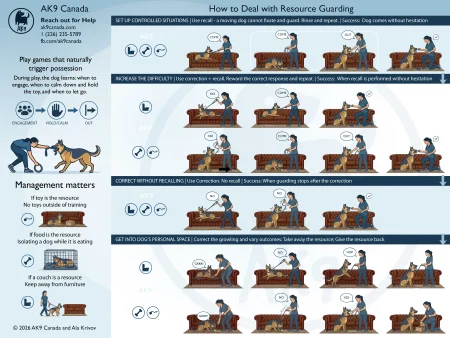
Download Free AK9 Resource Guarding Infographic
It is time to talk about resource guarding and how to address it.
In one of the popular “dog training advice” groups, I recently read a post about a young dog growling at a 9-month-old baby approaching while the dog was chewing a designated toy.
The parent and the dog owner, obviously concerned, focused on two questions: a) Is this resource guarding? b) What to do about it?
There was not a single sane comment under this post. Suggestions ranged from “he is warning you! Never correct a dog for growling!” to “he feels threatened by a baby and you need to find a positive reinforcement trainer to modify this behaviour so that he feels safe.”
I do not know how people arrive at the idea that this dog was not feeling safe or was acting out of fear. Is it the propensity to humanize dogs and try to find rational reasons for irrational and instinctual behaviours? Possibly.
The biggest problem with the humanizing, though, is that dogs, regardless of how compassionate and understanding you are towards them, will never become humans. And resource guarding is just one example of a behaviour that is very foreign to human beings and yet very common to canines. Therefore, assigning human emotions and suggesting human solutions to this problem is not just inaccurate—it is ineffective.
To be clear, yes, a dog possessing an object and growling at an approaching 9-months-old baby is definitely an instance of resource guarding. But it has very little to do with fear in the way people tend to think about it. The dog is not “threatened” by a baby. It is rehearsing an instinctive behaviour, and the baby simply appears to be an easy target that will not fight back.
Guarding what is yours is deeply ingrained in a dog’s mind. It is an ancient survival behaviour: once you possess a resource, you guard it. If you don’t guard it, you lose it and you die.
These days, when dogs do not really have to compete for resources, this instinct still kicks in whenever a dog feels like it is possessing something. This something can be a toy, a bowl with food, or a couch. Once that instinct kicks in, a normally sweet and docile dog all of a sudden produces a low growl and bares its teeth, scaring its humans with the nature of an animal that it is.
The key here is not to over-interpret this dog's intentions or reasons for resource guarding, but to build a mechanism to deal with the manifestations of it; the mechanism which can later resolve the resource guarding completely.
One way to go about it is to: 1) Teach the dog how to handle possession; 2) Gradually introduce this skill into the resource guarding situation; 3) Proof until the behaviour is solid.
Here is a more detailed breakdown:
- The dog has to learn how to handle the intrinsic urge to possess and not let go of the possession. The best way to do this is through games that naturally trigger it—tug being the most obvious one. During play, the dog learns three rules: when to engage, when to calm down and hold the toy without thrashing or chewing, and when to let go. This takes time—usually a few weeks of consistent work.
- In the meantime, management matters. The dog should be dragging a line, and there should be no opportunities to rehearse the behaviour. Crate, tether, isolate while the dog is eating (if food is the resource) or keep away from furniture (if a couch is a resource), but do not allow the possession to happen while you are building a mechanism to fix it.
- Once the dog has a solid “out,” set up controlled situations where it is given an opportunity to possess—but this time, you will be ready. The dog is on a leash; as soon as it takes something in its mouth (or just about to climb on a couch) and just before it takes the guarding posture, use a recall, followed by an “out” (if the possession was something that a dog carries in its mouth) once it comes. The leash helps with movement: a moving dog cannot fixate and guard. Rinse and repeat.
- Increase the difficulty. Let the dog possess something, allow the guarding posture, then interrupt it: a firm “no,” a leash correction, and immediately call the dog away. Reward the correct response and repeat.
- Correct the guarding itself without recalling. At this stage, the dog should disengage quickly, outing and stopping the guarding immediately.
- Finally, practice real-life scenarios. Let the dog take something, then reach for it with your hand—ready to correct if needed. Take the resource away and give it back at first, then vary the outcome so the dog does not assume possession is permanent but is also not concerned that it is never getting it back.
And absolutely no luring away from the object. It does not fix anything and, with a smart dog, can actually make the problem worse.
Need help with resource guarding? Reach out.