
At this point, I have made quite a few posts about common problems that many dog owners have, as well as multiple misconceptions that surround the process of training.
This post is going to be different. It is going to be about quirks that fall into a category of “nothing,” meaning that some issues are simply not worth bothering with, because the process of their correction can lead to a whole range of far more problematic behavioural patterns.
Let me lead with an example, as usual.
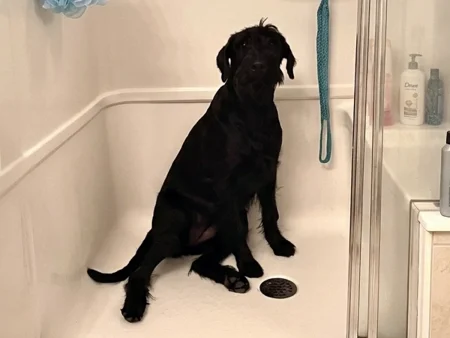
I have a dog with many quirks, with one of them being most prominent. My dog loves the shower cabin, God knows why. She sneaks into it and sits there with the guiltiest face you will ever see, as if she was caught doing a terrible mischief or if her rebellious and treasonous intentions have been shamefully uncovered. The real funny thing is that she does not do anything really bad, even though she perceives it as such.
I can contemplate about the reasons for such perception; they are fairly straightforward. There are some rooms she is not allowed to enter without permission or invitation, and bathroom is just one of them. Therefore, each time she sneaks into her favourite shower cabin she breaks the rules.
I could have corrected it, and some people would say that I should have. In fact, if I were a new owner who worked up enough courage to ask an internet community about this, I would have been strongly urged to fix it right away: today she sneaks into a shower, and next week she will occupy my bed. Sounds familiar?
Now, here is the thing. I allow my dog to “rebel” within the rules that I have established: I pretend to be surprised when I find her in a shower cabin, she indulges in guilty pleasure, I put on an “angry” face and ask her to leave the room, and Orca willingly does so. I know the rules, my dog knows the rules – we both enjoy the game.
Has she tried to push for more? Oh yes, absolutely. That beard was dipped in my toilet because the water obviously tastes better there. Did she succeed in a long term? No way.
The reason I allow her to do that is fairly simple: I want her to keep liking the shower. I never have to ask her to go there if I need to wash her, she is happy to comply. She melts into a cheerful puddle when I invite her to enter the bathroom and never resists any washing-related procedures. If you ask me, that is a big advantage. If all it takes is to close my eyes to a minor mischief, so be it. It is a “nothing” behaviour, and I am not going to make a big deal out of it.
Of course, my dog is not the only dog who has weird quirks. Some dogs like to bring random objects to their owners, such as slippers, hair ties, pieces of paper, loose pieces of jigsaw puzzle. Is it worth correcting? Probably not, it is another “nothing” behaviour. If your dog brings this to you with an intention to “share,” it is an excellent instinct to nurture. Correct it, and you might end up having issues if you ever want to teach your dog to retrieve.
Now, the most important question is: what is the difference between a “nothing” behaviour and a behaviour that needs attention? A “nothing” behaviour does not undergo many changes over a short period of time; it is usually performed openly; and it does not cause any damage to your belongings or your dog. It is benign.
For instance, a dog who brings you slippers and who is consistently giving them to you, is exhibiting a “nothing” behaviour. However, a dog who runs away with your shoes and tries to swallow them whole has clearly passed the line between the two.
Any behaviour that has to do with the signs of aggression, even the most minor ones, is NOT a “nothing.” A dog who runs away and comes back when it pleases is not doing a “nothing.”
The point is: not every single mischief needs to be corrected. However, it is important to keep the boundary firm and to know the difference between a mischief that both you and your dog can enjoy and a trouble waiting to happen.