
Puppies explore the world around them through their mouth, and their single strongest drive (after pack drive) is finding food.
Everybody knows that food often plays an essential role in formal training. We use food to create reward events; we delay food rewards to encourage anticipation and energy; we withhold treats to punish for incorrect behaviours. All these operations, however, require that a dog’s food drive is strongly present and that the dog understands the essence of the behaviour-food reward sequence.
Putting all the complicated verbiage aside, this concept is rather straightforward: a dog understands that it needs to do something to receive food. How can you get there? By teaching the concept of luring.
Luring means that you can “steer” your puppy’s nose—and, by extension, its whole body—in the desirable direction by using a piece of food in your hand. That is, your puppy will smell the food and will follow your hand wherever it goes.
If you hand-feed your puppy a few times, holding pieces of their meal in your hand and making them follow this hand either to the sides, or in a circle motion (foundation for your “spin” command), or to the floor and up (foundation for “downs” and “sits”) before getting the food, they will grasp the essence of this game. You don’t have to say anything, just make them follow your hand.
Do it daily, for a few weeks, and you will have a dog who firmly understands that following your hand results in being fed and who will never struggle with learning “down” or “stand.”
A young puppy will grasp the concept of luring fast, almost automatically, as if this luring information was somehow imprinted onto their frontal cortex. You show them a piece of food, and they will chase after it, trying to grab it. However, with age, dogs tend to lose this food-chasing intensity, and, unless you taught them luring early, it might be difficult to teach it later (depending on a specific dog’s food drive, of course).
I know, I know, many prominent trainers dislike luring, as it tends to firmly sit in the niche claimed by “positive-only” trainers, who turned luring into bribing. There is a big difference between luring and bribing, though! With luring and a solid understanding of proper reward timing, you can shape pretty much any behaviour you want, and then, once the dog understands whatever you are teaching, food can be gradually removed from the picture.
The things you can do with luring are truly unlimited. Tricks, obedience, agility, service work, scent work—anything. Moreover, teaching luring will help strengthen and significantly improve your dog’s inherent food drive, which they might lose with age if you are not applying it to anything. And you know why food drive is good? Because food drive easily translates into motivation to work, and when your dog is motivated to work, the sky is your only limit.
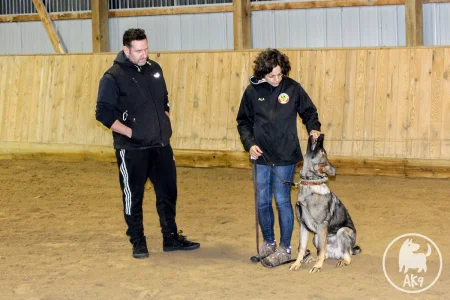
(In the picture is a 6-month-old German Shepherd puppy who was not taught the concept of luring, hence his crocodile move in an attempt to remove my hand from my body. He successfully learned luring after a few classes, though)