
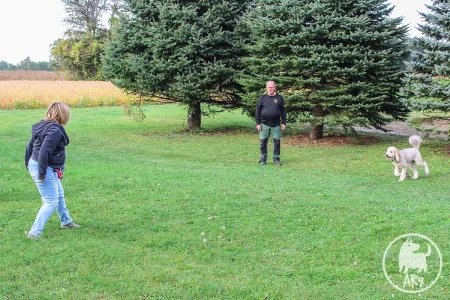
I became a witness to a curious event this morning.
In the middle of our usual park walk, I heard a loud and angry “Come! Come here NOW!” I turned my head and, across a field, saw a tall guy running and waving his hands in frustration. I looked to the opposite side and, sure enough, saw a dog who, evidently, was having the time of its life running away from its owner.
Before I could say anything, the dog ran into the street (thankfully empty at that hour), and the owner followed.
I do not know how many of you have found yourselves in a similar dog-chasing situation, but from my experience, I do know that it happens—and whenever it happens, the sequence remains the same: dogs keep running away, and their people keep chasing them.
In these situations, I always wonder: do people realize that dogs keep running away partially because they are being chased?
There are several reasons for this behaviour.
First, solid recall has to be taught early. No recall = no freedom without control. Running is a self-rewarding experience; every time a dog gets to run away, it rewards itself with the thrill of the chase and the very act of running (which is fun).
Second, if it so happens that your dog gets off-leash (unintentionally), never chase it. If you do, the dog will either perceive it as a great game or get scared and up its running-away game.
Instead, do something absolutely counterintuitive: run in the opposite direction and hide behind a bush or a tree. As you are moving away, call your dog so that it looks at you—but do not stop moving away. Chances are your dog will actually start chasing you (best-case scenario) or will stop running away and freeze (worst-case scenario). Either way, it will stop running, and if you hide, it will come looking for you.
This hide-and-seek game, in fact, should be played outside of an emergency context. Throw your dog its favourite ball and, while it turns to chase it, hide. Be silent and wait for the dog to realize that you disappeared. Call it—and enjoy the enthusiasm and speed with which it comes to you.
Third, people often punish completed recall that they perceive as “bad,” such as when the dog did not come back right away or came back very slowly. A dog who came to you can never be punished. If it is punished, it will stop coming back to you.
Finally, people like to call their dog only when it is time to (a) go back inside or (b) put the leash on and walk home. It is not fun, and dogs quickly realize that recall equals the end of fun. Practice recall randomly and in different contexts, so the dog learns it as a happy, rewarding command.
In the end, all creatures want what they cannot have. If you make yourself that “cannot have,” or something your dog has to work to keep, coming back to you will feel much better than running away.