
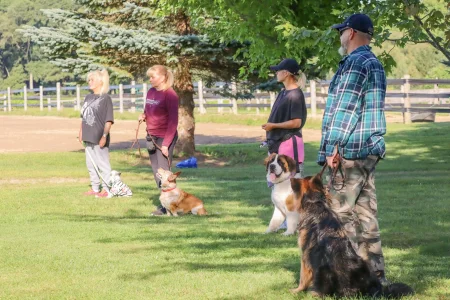
A new trend has emerged in the dog training world.
A trend that is a by-product of cancel culture; a trend that claims that obedience training is an unnecessary, redundant, and in some instances cruel, intervention into a dog’s understanding of how this world functions.
It started softly, with small changes and familiar terms. “Focused heeling” was replaced with “engagement.” Recall—with “relationship-building.” Sit-stays and down-stays—with “consent-driven position changes.”
Then, as it often happens, these seemingly innocent changes turned into a full-blown pushback, with a foundational message claiming that making dogs obey is an outdated attempt to dominate a species different from our own.
Heeling is framed as a restriction of a dog’s natural movement.
Having a dog come to you is called an attack on their freedom of choice.
Making a dog sit and wait is described as abuse through abandonment.
I figured it was time to show whoever reads this post what obedience actually is—and what kind, wonderful, and even healing things can be done through it and with it.
Obedience skills can significantly improve lives and, at times, save them.
Example 1: A person struggling with a severe form of vertigo or blood-pressure issues cannot lean over to pick up dropped items. Using the obedience commands “retrieve” and “come,” a dog can be taught to pick up these items and present them to its owner.
Example 2: A person suffering from PTSD might experience panic attacks so severe that, unless someone physically holds them, they lose their sense of reality and may even stop breathing. Through obedience commands such as “hop” (put front feet on a person) and “stay,” a dog can be taught to apply pressure and bring this person’s struggling mind back into the present.
Example 3: A person lost in the woods and injured has a very small chance of being found by someone on foot or even by helicopter. A dog, however, through the obedience commands “track” and “indicate,” can be taught to pick up a scent that is up to a week old.
Don’t like human examples? No problem—let’s talk about animals.
Example 4: A stubborn but bold (and not very bright) sheep has a high chance of wandering off into the wilderness because it thought a patch of grass looked better than where the rest of the herd was heading. Through obedience commands, a dog can be taught to drive this sheep back to its handler and save it from being eaten by wild animals.
Finally, here are some fun—or very useful—things that can be taught using only “heel,” “sit,” and “come”:
•You are walking your dog and suddenly see a baby goose wandering into the street. You tell your dog to “sit,” drop the leash, retrieve the baby goose, and place it safely on the sidewalk.
•On your morning walk, you meet someone you haven’t seen in years, but who is allergic to dogs. You tell your dog to “sit,” drop the leash, approach the person, have a conversation, and then return to your dog.
•You have guests. They become overly excited about your dog. That excitement might transfer to the dog—or it might trigger its defense. Rather than testing which way it goes, you use your “come” command, reward the dog, and either take it to another room or ask it to “sit” and wait until the guests calm down.
•You have a new child. The dog shows too much interest, trying to poke a sleeping baby with its nose. You approach your dog, ask it to “heel,” and escort it away from the crib. Going forward, you are mindful to keep the dog and the baby separated.
•You are in an off-leash area when a squirrel suddenly runs toward a busy road. Your dog starts the chase. You use your “come” command. The dog disengages—and stays alive.
I could keep going, but you get the idea. So, is obedience restrictive? Of course it is—but so is the world around us.
My body is built in a way that prevents me from flying, and that restricts my physical abilities.
My salary will never allow me to become a millionaire, and that makes me a little sad.
A Facebook page, set-up as a "business page," prohibits me from initiating conversations with people. Does it upset me? Sometimes.
Why should it be different for dogs?
We are all guests in this world, and the rules of this world do not bend for any species. Your dog knows this and is ready to take it on. Robbing it of the opportunity to learn those rules is a cruelty far greater than asking it to hold a long “down.”