
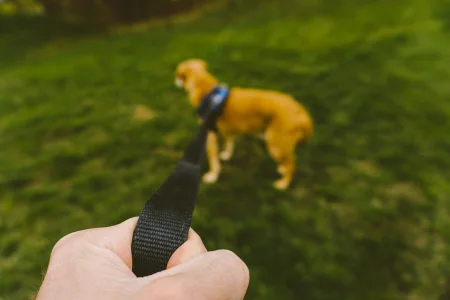
You know what the most dangerous piece of equipment for dogs is?
It isn’t a prong collar.
It isn’t an e-collar.
It isn’t even a head halter or a choke chain.
It’s a nylon leash.
Pet stores are flooded with these cheap, colourful leash impostors. They come with all kinds of “helpful” features: extra loops, poop-bag holders, bungee sections, even chain inserts.
And yet, they completely fail at the one job a leash is meant to do: safely lead and contain a dog bigger than a toy breed.
They’re slippery.
They burn your hands.
They soak up water.
And their clips love to snap when a dog pulls—usually at the worst possible moment.
Those extra attachments? Useless at best, actively harmful at worst.
Your leash is your primary instrument of communication with your dog. It must be comfortable to hold and strong enough to trust. It must also be uniform along its entire length, because the whole leash is functional—allowing you to shorten, lengthen, and adjust in real time.
Once you add loops, bungees, chains, or accessories, parts of the leash stop being usable. The tool starts dictating how YOU must use it, instead of adapting to what you and your dog ACTUALLY need.
I tell my clients this all the time: at least 50% of training success depends on leash quality, especially with pullers or reactive dogs. That’s not an exaggeration. The importance of a good leash is truly impossible to overstate.
And here’s the frustrating part: good leashes are now incredibly hard to find. I have no idea what cultural shift pushed solid leather leashes out of pet stores, but they’re nearly gone. Biothane—an excellent modern alternative—is usually only available through small local makers, which many people don’t have access to.
So most owners never even get the chance to realize how much easier their life could be...
all by choosing a different leash.
A leash isn’t just an accessory or an annoying by-product of dog ownership. It is a communication device—like your favourite phone. It can be a lifeline, a gentle guide, or the only barrier between your dog and a fast-moving car.
Do spend time choosing one, and avoid pet-store nylon leashes like the plague. They are designed to set you up for failure, and the fewer people who buy them, the better our chances of finally seeing well-made, comfortable leashes back on store shelves.