
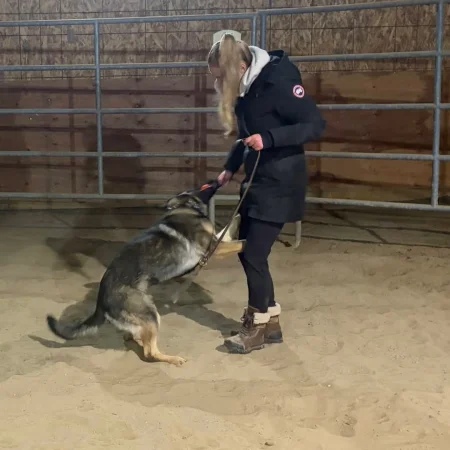
The more I listen to my clients, the more I realize that there is a profound confusion about what playing with a dog actually is.
On one side are famous trainers who advertise play as the ultimate strategy every dog owner must use. On the other side are everyday dog owners who see their dog turning into an exuberant, mouthy, and unruly animal during play. They either perceive play as something that makes their dog “angry” or as something necessary but annoying, best outsourced to other dogs.
Both sides have a point, and both sides are wrong.
Trainers who claim that every dog must be trained through play make life difficult for owners of super chill, low-drive dogs. Yes, it is possible to develop play drive in any dog. But if a dog has a decent food drive but zero prey drive, why not use the food?
Owners who panic because their dog suddenly becomes extremely driven to bite a toy often believe this desire makes their dog aggressive. They either stop playing altogether or let the dog “win” in all the wrong ways.
To be a successful training strategy, play MUST have rules:
Rule 1: The style of play (chasing a ball, biting a tug, or simply messing on the ground) must be highly valued by the dog.
Rule 2: The dog must bring the toy back—so, at first, play is done on a long lead.
Rule 3: The dog must release the toy on command, using a drilled “out” command.
Rule 4: The dog must understand the difference between tugging/shaking and holding calmly, achieved through a “hold/okay!” command sequence.
Rule 5: Play makes dogs truly happy, so it can be used as a reward for obedience—but it must also be its own thing.
With these rules in place, you can practice almost any skill during play, and your dog will love it.
Common ineffective play looks like this:
- Your dog loves chasing a ball but will not bring it back.
- Your dog brings a toy back but refuses to release it.
- Your dog runs away with the toy once it has it in its mouth.
- Your dog growls and snatches the toy out of your hands despite your trying to delay this grabbing.
All of these create bad habits. How to fix it? Super easy: read the rules, attach a leash, visualize a clear end picture, and reach out if you are confused.