
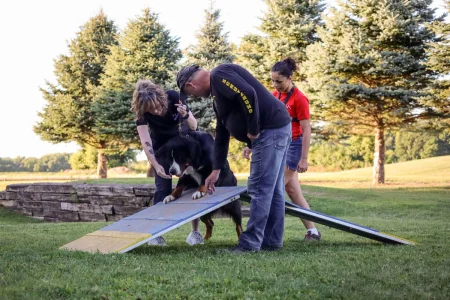
Despite the fact that there are as many training approaches as there are dog trainers, when it comes to thresholds, there are only two camps: the ones who use thresholds as an excuse to keep their dog in a state of perpetual fragility, and the ones who do not believe that a healthy and resilient creature, which most canines are, has to have one.
The idea of a "threshold" is an elegant metaphor that represents the lack of capacity of a dog to process certain stressful events. The word itself originates from an Old English word "prescold" which means "entry point," which basically referred to a piece of wood one steps over when entering. When used metaphorically and in dog training, it implies that every dog has this point at which they start struggling to "cross" and move on.
While it is true to some extent — after all, the human world is full of things that a young and inexperienced dog might find scary — there is little value to working "below" those thresholds in hopes that one day (a day which may never come) the threshold will be pushed further and then eventually disappear. Because, if a dog is not taught how to cope with a briefly stressful event, it will find other "thresholds" to be anxious about.
I am not sure how this obsession with a dog's psychological comfort overrode common sense, but I very often see owners who patiently wait for their dog to unfreeze and move forward because a particularly scary butterfly was getting close to it. Owners who do not punish barking and lunging because they believe that this behaviour is their fault for not keeping the dog under "threshold." I have even had people reach out specifically asking whether there will be an opportunity to step out of a group class in case they feel the dog is getting too close to this imagined "threshold."
I call bullshit on it.
Abiding by the idea of keeping a dog under a threshold is stressful, complicated, ineffective, and, ultimately, abusive. Do you want to enjoy a life with your dog, or do you want a lifestyle that revolves around catering to your dog's perceived "special needs" — and, in doing so, stripping your dog of the very freedoms that come with the absence of those "thresholds"?
If you want the freedom to go places with your dog, start acting like it. Do not indulge fears. Help the dog move through the things it perceives as scary, instead of freezing, turning around, and trying "another time" or choosing different routes.
What does that look like in practice?
Remain emotionally neutral when a dog shows discomfort. Example: a dog is hesitant to walk past strangers. The closer you get, the more nervous the dog acts. At some point, the dog starts backing up, trying to get out of its collar, throwing a fit — you got too close to what the dog perceives as dangerous, or, as threshold advocates will claim, you pushed beyond its "threshold." You have two options: a) Emotionally engage — try to calm the dog with your words and touch, then remove both of you from the situation by increasing distance. Or b) Remain emotionally neutral, wait for the dog to be done with its fit, and move on without acknowledging it with so much as a raised eyebrow.
To speed things along, you can even — o horror! — punish the reaction itself: take hold of the collar, apply pressure, and tell the dog to knock it off.
What happens to the "threshold" then? It ceases to exist. Your dog won't suddenly love strangers, but it will absolutely stop acting like an idiot when strangers approach. You will not traumatize your dog. It will not hate strangers more. It will not hold a grudge. There will be no suppressed emotions, no hypothetical fallout — none of the imagined consequences perpetuated by people who have tremendous compassion for animals but have never actually trained one.
What you will do is teach your dog something about resilience, coping with stress, and confidence. And you will learn something about "thresholds" too. That is, they exist only insofar as you insist they have to.