
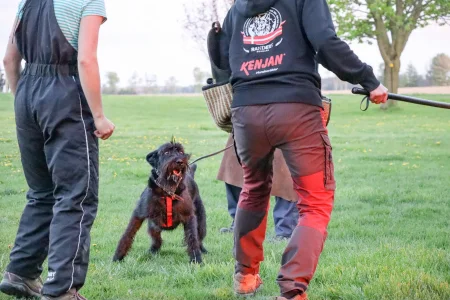
You know what the biggest problem is with “reactive” dogs?
It’s the fact that their “reaction,” along with its very source, is often misunderstood as fear or outright aggression.
While there are certainly dogs who bark and lunge out of fear in a defensive attempt to drive a perceived threat away, the majority of dogs we regularly see are simply displaying behaviours that are normal to the species: a mix of possession and prey drive.
Regardless of how many times people tell themselves that dogs are “furbabies” and gentle souls who only need compassion and kindness, reality remains reality. Dogs are opportunistic predatory mammals that learned to live alongside humans because of that very opportunism and adaptability.
That means that even if a dog exhibits a completely docile demeanour in 90% of life situations, there will always be those remaining 10% where predatory instincts kick in. And when they do, people often seem almost offended by it, immediately applying labels associated with fear, trauma, or pathology rather than recognizing normal canine behaviour.
From there, the pattern usually goes one of three ways:
a) “My dog is lunging at other dogs because it wants to play — as soon as it gets close, it becomes friendly.”
b) “My dog is lunging because it is afraid — I need to find a behaviourist who will rewire this mindset.”
c) “My dog is aggressive and hates other dogs.”
The truth is that there are many reasons why a dog puts on an animated display when it sees another dog. Most often, though, it comes down to a combination of reinforced frustration (the dog barked once and was then allowed to reach another dog), prey drive (“moving object, chase it”), and possession, which is especially prominent on leash.
What’s most interesting — and something owners almost never suspect — is that many dogs actually enjoy these “reactions.” The barking, lunging, and pulling create excitement and stimulation. The behaviour is self-reinforcing.
So how do you deal with reactivity?
The same way we deal with anything: do not treat it as a symptom of some kind of mystical past trauma, mental illness, or paralyzing fear, because it most often is not. In most cases, a barking and a lunging dog is simply a dog who has not been told to knock it off and shown that this behaviour is pushy, bratty, and unacceptable.